History
The history of our First Congregational Church of West Brookfield extends back to the earliest Puritan settlements in Massachusetts. In 1665 a small group of men from Ipswich, having obtained a grant from the Puritan authorities in Boston, came out over the Old Bay Path through what was then wilderness to a place called Quaboag. They chose to make their settlement, called “Quaboag Plantation” on the top of a hill (today’s Foster Hill) about a mile from where our Church is located today. One of the requirements for a new settlement in those days of strict Puritan control was that provision be made for religious worship, and accordingly a meeting house was built. The meetinghouse served a dual purpose as a place of worship and a place of government.
Over the next 10 years the settlement’s population grew to about 73 persons, and in 1673 its name was changed to “Brookfield.” All seemed to be going well.
But in 1675 King Philip’s War broke out and eventually reached Brookfield. The settlement was besieged by an estimated 300-500 Native American warriors, and the inhabitants fled for refuge to the nearby Ayres tavern. The siege lasted almost 3 days, but just when it seemed catastrophe was near, the inhabitants were rescued by a troop of mounted men from Marlborough. The settlement’s buildings, however, including the meeting house, were burned to the ground. The surviving settlers fled to other places, and the area was abandoned for about 10 years.
Small numbers of settlers continued to arrive in other parts of the grant, however. By 1688 there were enough to justify the building of Fort Gilbert, near today’s West Brookfield Elementary School. Fort Gilbert served as a place of worship and a place of safety during continued insecure times. It was a period of struggle between France and England for control of North America, and Native American warriors were used by France to harass English frontier settlements such as Brookfield.
By the end of Queen Anne’s War in 1713, however, the theatre of conflict shifted, and the Brookfield area became relatively secure. Settlers began to pour in, and by 1715 there were enough to justify the building of a new meeting house. Accordingly, a new, much larger meeting house was built in 1717 on the same site on Foster Hill where the original had been. Rev. Thomas Cheney was ordained and called as its minister.
This 2nd meeting house stood on Foster Hill from 1717 until 1755. This period was one of rapid population growth and increasing economic prosperity in Brookfield, and the meeting house stood on the busy Boston Post Road.
The “Great Awakening,” as it was called, took place during this period in a reaction to a decline in religious belief. One of its most famous proponents was the Methodist preacher George Whitefield, and in 1740 Rev. Whitefield came to Brookfield, and standing on a large rock (Today’s “Whitefield Rock”) a short distance from the meeting house, preached to a large gathering in an open field. Puritan ministers, Rev. Cheney included, were at first skeptical of the emotionalism engendered in mass revival meetings such as this, but eventually came to accept them as contributing to religious faith. The tradition is continued today by the West Brookfield Methodist Church and the Congregational Churches of the Brookfields who join together near the ”Whitefield Rock” each Easter for an ecumenical sunrise service.
As the population of Brookfield continued to grow, however, a serious problem developed. Puritan belief still mandated compulsory observation of the Sabbath. But many of the new settlers lived too far away from the meeting house to make this possible. The residents of today’s North Brookfield were the first to break away, and not long after Rev. Cheney’s death in 1747, obtained permission to become a 2nd parish and build their own meeting house. In 1754 the residents of today’s Brookfield followed suit and became a 3rd parish with a meeting house near today’s Brookfield town Common. And finally, in 1757, those remaining, still designated the 1st parish, built a new (3rd) meeting house in today’s West Brookfield near the town Common. The meeting house on Foster Hill was dismantled, and the lumber used for other purposes. The 3rd meeting house stood from 1757 to 1795.
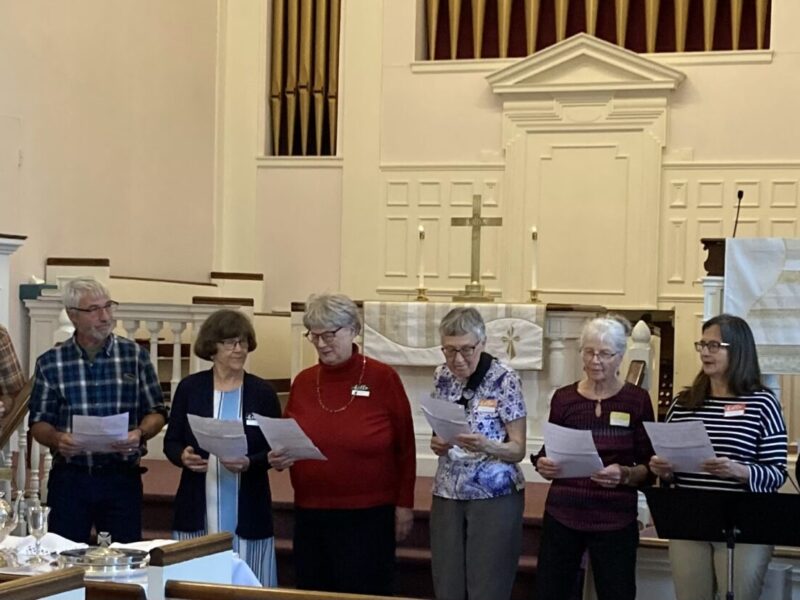
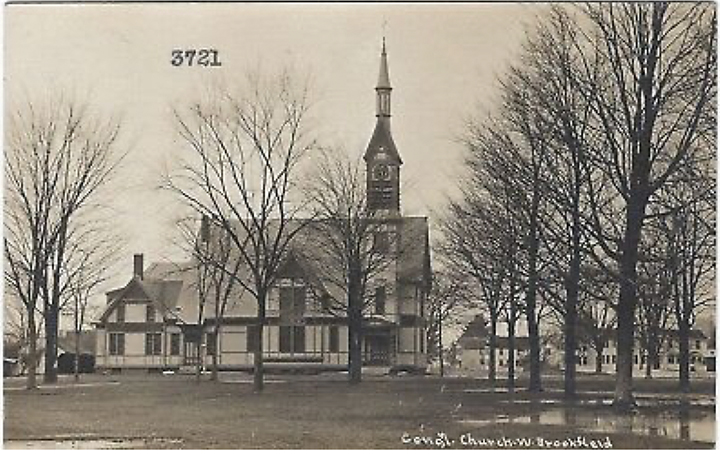
In 1795 a new, larger 4th meeting house was built near the same location, and the 3rd meeting house was removed. This 4th meeting house stood from 1795 until 1838, when it was remodeled and greatly enlarged into a church building. Until the American Revolution and the subsequent separation of church and state by Massachusetts in 1833, all these meeting houses served the dual function of places of worship and places of government. They were independent and self-governing, and the town meeting form of government was developed in them, thus preparing the way for democracy on a national scale when it finally came. Abolitionist Lucy Stone grew up in West Brookfield and was a member of our church until 1851, when she was expelled for both her anti-slavery views and her determination to have her voice heard by voting. During our 300th Anniversary celebration in 2017, we apologized for the actions of our ancestors towards Lucy Stone, celebrated her leadership, and invited her back into membership through a dramatization held in our sanctuary.
In 1964 we joined the United Church of Christ and became a covenanted part of that larger body. Our more recent history includes being known in the community as the church on the Common that opens its doors in times of community strife (9/11 Ecumenical Service, Service of Comfort after the tragic deaths of a local family, etc.); the church that sponsors the Annual Flea Market on the Common, serves up gallons of our secret-recipe asparagus chowder each May at the town’s Asparagus Festival, Flower and Heritage Festival; hosts other wonderful suppers, participates in the town-wide White Christmas Celebration; regularly supports mission, locally, nationally, and globally; and offers vital support to address food insecurity through The Sharing Cupboard food pantry.
History marches on, and so do we!
-Dave FitzGerald, Church Historian